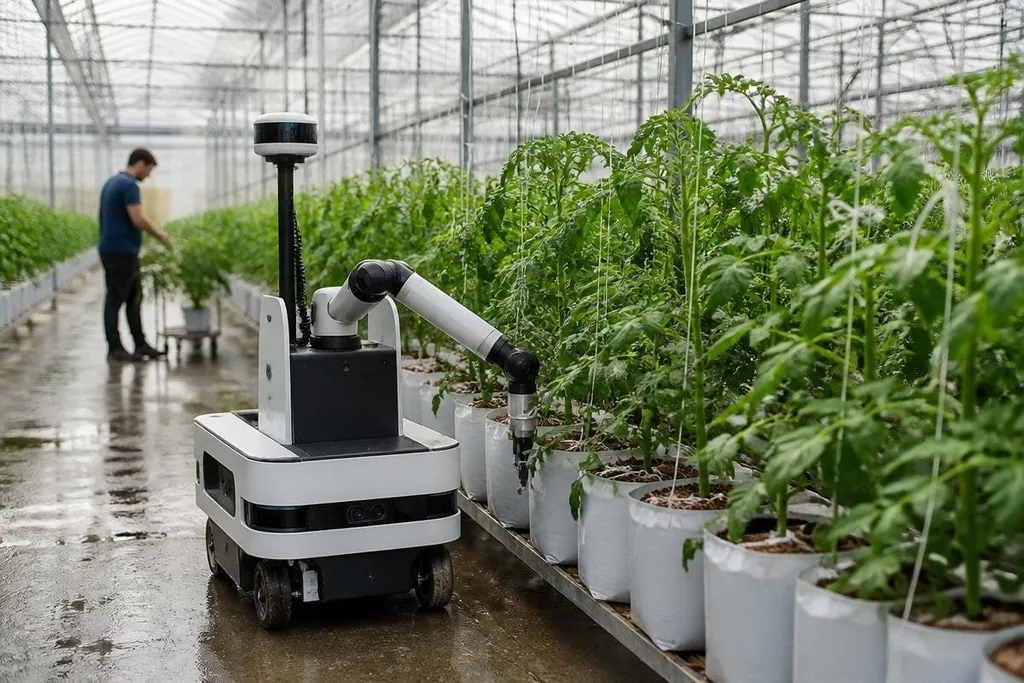
A greenhouse gives robots a hard job: work around living plants, wet floors, narrow paths, changing light, and crops that rarely grow in the same shape twice.
The next useful machines will need to handle those conditions for a full workday, not only complete a clean task in a short video.
- Picking must avoid bruising fruit and breaking stems.
- Mobile robots need safe routes around workers, carts, and plant rows.
- Buyers will need clear costs, repair plans, and proof from working greenhouses.
Where robots can help first
Greenhouse work contains many repeated tasks, but repetition alone doesn't make a task easy for a robot. A machine must find the right plant part, judge its position, control its force, and recover when leaves hide the target.
Transport may be an earlier use. A mobile robot could carry trays, tools, or picked produce between rows and a work area. That task still needs safe movement, obstacle detection, and a way for workers to load and unload it without slowing the job.
Crop checks are another possible use. Cameras and other sensors can look for changes in color, shape, or plant position. Those readings may help staff decide where to inspect, but a useful system would need to show how often its findings are correct under different light and crop conditions.
Harvesting remains harder. A gripper needs enough force to hold produce and little enough force to avoid damage. The robot also needs a clean cut or twist, a way to place the crop in a container, and a recovery plan when the fruit is hidden or out of reach.
The greenhouse is a difficult worksite
Indoor farming removes some outdoor problems, but it adds its own limits. Rows can be narrow. Plastic, glass, water, and leaves can confuse cameras or change how sensors read a scene. Condensation can affect hardware, while dirt and plant residue can reach joints, wheels, or grippers.
A robot that works in one crop row may fail in another. Plant height, spacing, fruit color, and support wires can change the task. That makes setup and software changes part of the purchase decision, not a detail for later.
Workers matter too. A greenhouse robot must make its actions easy to understand and easy to stop. Its route should leave enough room for people, and its handoff should fit the way staff already sort, carry, and pack produce.
A greenhouse buyer needs reports that connect a robot’s crop, task, test site, and worker input to its results. Robot24.com can help you check whether a machine fits the rows, handoffs, and safety steps your staff already use.
What buyers will ask for
The future market will turn on evidence that connects robot work to crop results and operating costs. A maker may claim that a robot can pick, inspect, or carry, but a greenhouse operator needs a fuller set of answers.
The useful figures will include task time, successful picks, damaged produce, stops that need a worker, charging time, cleaning needs, and repair time. A short trial can show that a task is possible. It cannot show whether the machine fits a full growing cycle or earns back its purchase and service cost.
The open question is adaptability. A machine built around one crop may work well for that crop and lose value when the grower changes varieties or row layouts. Software updates may help, but the operator still needs a clear process for testing changes before they reach live plants.
A practical buying check
Use this list before treating a greenhouse robot as ready for daily work:
- Name the task: Set one job with a clear start, finish, and success measure.
- Check the crop: Test different plant sizes, fruit positions, leaves, and support structures.
- Measure human stops: Record every point where a worker must guide, reset, load, or clear the robot.
- Price the whole system: Include grippers, sensors, charging, cleaning, software, service, and training.
- Plan for failure: Ask how the robot behaves when it loses an object, blocks a row, or detects an unsafe person nearby.
- Run a site trial: Use the greenhouse's own rows, lighting, floor, staff, and crop cycle.
I'd wait for results that show crop quality and labor impact over a meaningful work period, not a task completed once.
Greenhouse robots have a practical path in transport, inspection, and other repeatable work. Harvesting will need more proof, because the machine must protect the crop while working through the conditions that make each plant different.